Cart
Your shopping cart doesn't have any products yet!
⸻
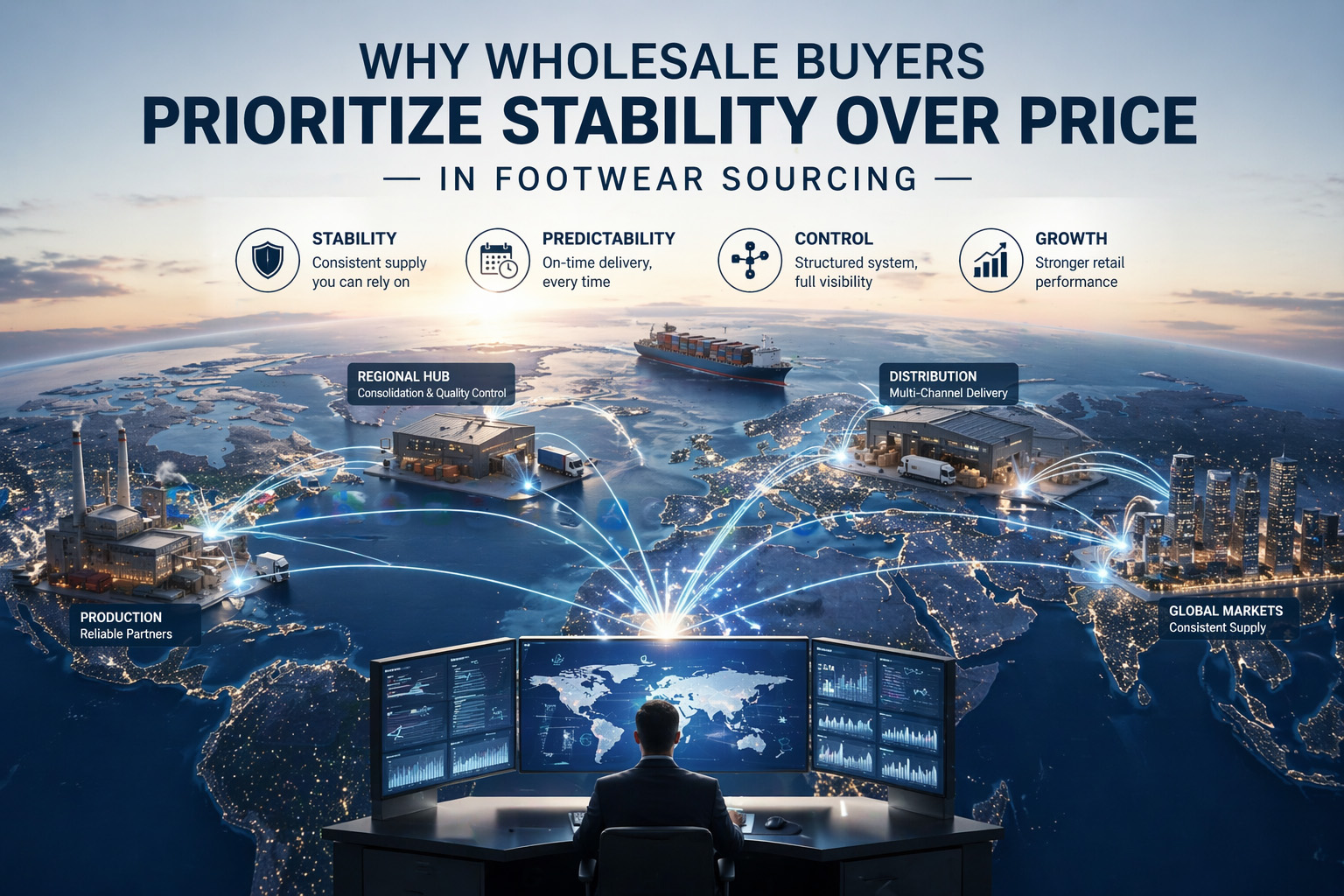
Why Wholesale Buyers Prioritize Stability Over Price in Footwear Sourcing
In footwear wholesale, sourcing decisions are often assumed to be driven by price.
Lower cost is typically viewed as the primary advantage.
However, in practice, experienced wholesale buyers do not prioritize price above all else.
They prioritize stability.
As global trade becomes more fragmented and supply systems more complex, the ability to maintain stable operations has become more valuable than short-term cost savings.
⸻
The Hidden Cost of Price-Driven Sourcing
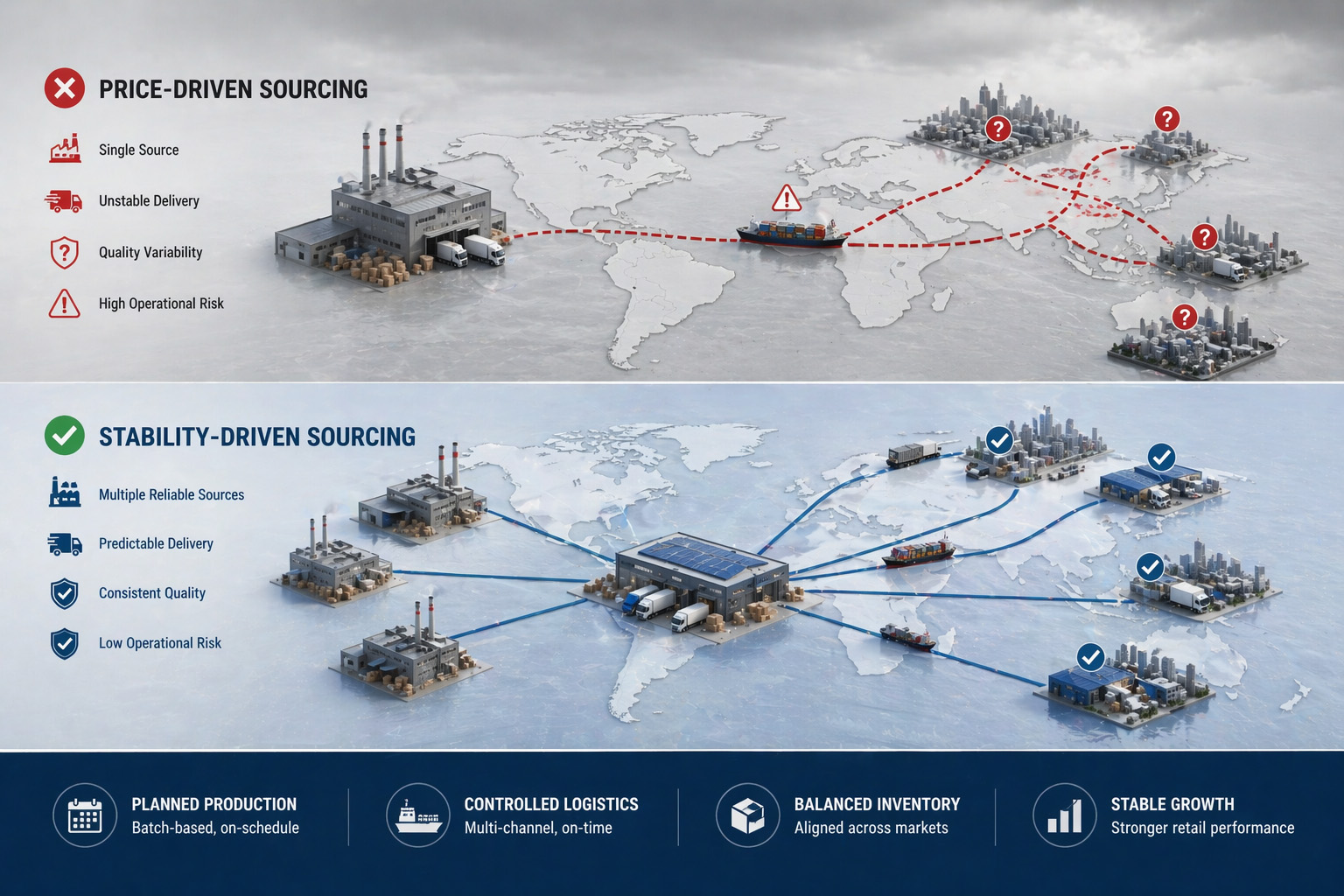
Price-driven sourcing often appears efficient at the transaction level.
Lower unit costs can improve margins in the short term.
However, this approach introduces structural risks:
• inconsistent product quality across batches
• unstable production timelines
• disruptions in shipping and delivery
• lack of coordination with retail demand cycles
These issues create hidden costs that are not immediately visible in pricing.
Over time, variability in supply can erode margins, disrupt retail operations, and reduce overall system efficiency.
⸻
What Stability Means in Wholesale Sourcing
Stability in sourcing is not defined by a single supplier or a single shipment.
It is defined by system-level consistency.
Stable sourcing systems are characterized by:
• predictable production schedules
• consistent product specifications
• coordinated logistics execution
• aligned replenishment cycles
Rather than optimizing for isolated transactions, stability focuses on maintaining reliable performance across the entire supply chain.
⸻
Why Experienced Buyers Choose Stability
Experienced wholesale buyers understand that sourcing decisions affect more than procurement costs.
They influence the entire operational system.
When stability is prioritized:
• inventory planning becomes more accurate
• retail replenishment becomes predictable
• logistics coordination improves
• operational risk is reduced
In contrast, price-driven sourcing introduces variability that can disrupt downstream processes.
For wholesale buyers managing multiple markets, stability becomes a strategic advantage.
⸻
Stability as a Competitive Advantage
In competitive retail environments, consistency matters.
Retailers rely on:
• reliable product availability
• stable restock timing
• predictable product quality
Wholesale suppliers that provide stable systems enable their partners to operate with confidence.
Over time, this reliability strengthens long-term business relationships and supports sustained growth.
⸻
Stability in a Fragmented Trade Environment
In a fragmented global trade environment, external uncertainty cannot be fully controlled.
Regulations, logistics conditions, and market dynamics continue to shift.
However, internal stability can be designed.
Wholesale systems that prioritize stability are better able to:
• absorb disruptions
• maintain continuity across regions
• adapt without compromising performance
This makes stability not just an operational feature, but a strategic capability.
⸻
Conclusion
In modern footwear wholesale, price is no longer the sole determinant of sourcing decisions.
Stability defines long-term performance.
By prioritizing structured sourcing systems over short-term cost advantages, wholesale buyers can reduce risk, improve predictability, and build more resilient operations.
In complex global markets, the most efficient system is not the cheapest — it is the most stable.
⸻